

In modern facilities such as office buildings, factories, hotels, hospitals, schools, and shopping malls, an Extra Low Voltage (ELV) system serves as the backbone that connects people, devices, and data. Beyond enabling communication, ELV systems enhance security, streamline operations, and provide the foundation for Smart Building and IoT applications.
A well-designed ELV infrastructure implemented from the early stages of a project helps building owners reduce operating costs, improve management efficiency, simplify future expansion, and maximize the long-term value of the facility.
What is an ELV System?
An Extra Low Voltage (ELV) system refers to a low-voltage infrastructure used for data transmission, monitoring, automation, and the management of various technical systems within a building.
Unlike the electrical power system, which supplies electricity to equipment, an ELV system focuses on connectivity, communication, and intelligent control, enabling multiple building systems to operate seamlessly together.
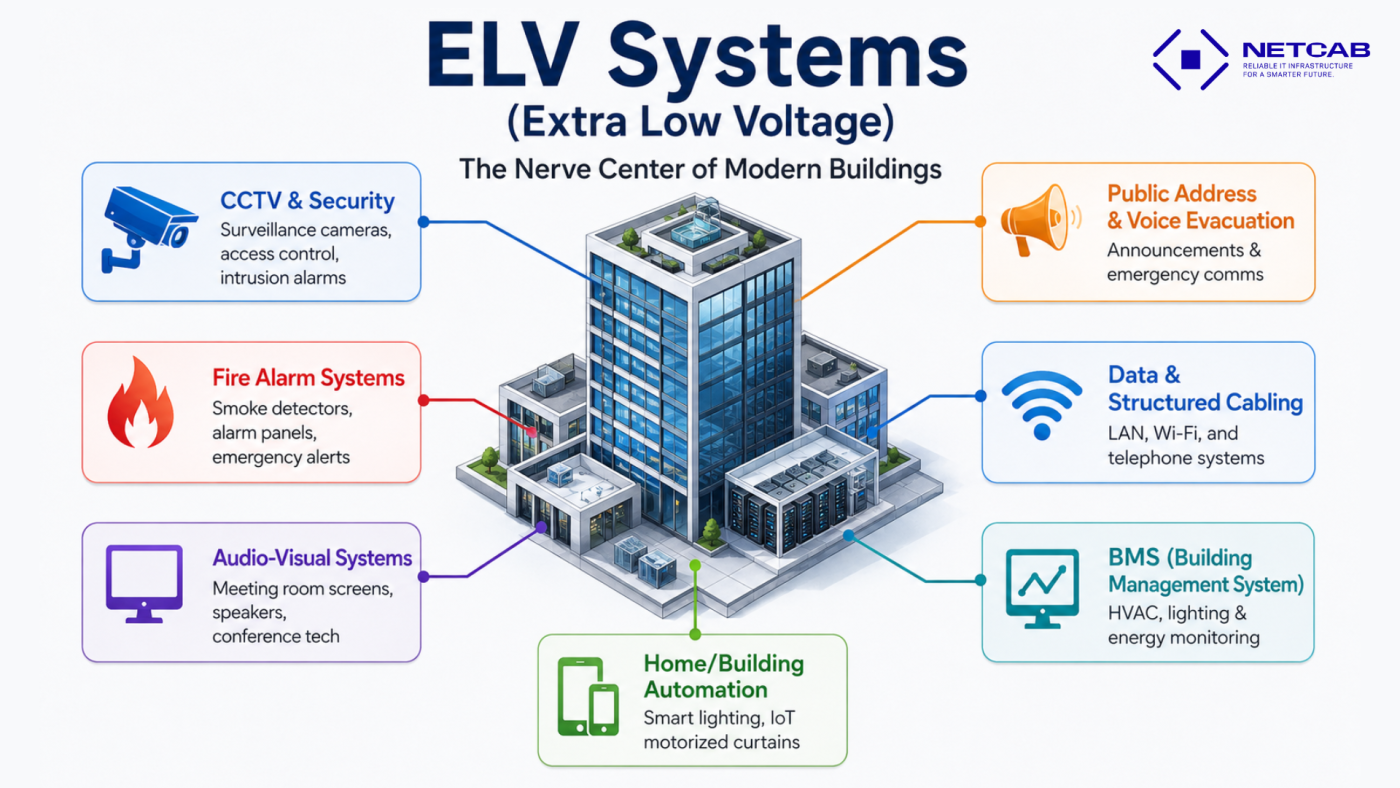
A complete ELV system helps a building to:
- Enhance safety and security
- Centralize the management of building systems
- Improve operational efficiency
- Reduce maintenance and energy costs
- Enable Smart Building and IoT integration
Core Components of an ELV System
1. Structured Cabling & Network Infrastructure
The network infrastructure forms the foundation of every ELV system. It connects all devices—including CCTV cameras, enterprise Wi-Fi, Access Control, Building Management Systems (BMS), and IoT devices—ensuring fast, reliable, and secure data transmission.
A typical network infrastructure includes:
- Structured cabling (Cat.6/Cat.6A)
- Fiber optic backbone (OM3, OM4, OS2, etc.)
- Patch panels and rack cabinets
- Network switches and routers
- Network security appliances (Firewalls)
- Enterprise Wi-Fi systems
The Importance of Firewalls
A Firewall is now an essential component of modern network infrastructure. It monitors and controls traffic between the internal network and the Internet, preventing cyberattacks, unauthorized access, and protecting critical systems such as CCTV, Access Control, and BMS.
As more ELV systems operate over IP networks and cloud platforms, implementing network security from the outset is crucial to ensuring business continuity and system reliability.
Benefits
- Provides stable connectivity across all systems
- Enables high-speed data transmission
- Protects the network from cyber threats
- Controls network traffic and unauthorized access
- Supports future expansion
- Serves as the foundation for IoT and Smart Building technologies
2. CCTV Surveillance System
A CCTV system provides real-time monitoring, video recording, and enhanced security management throughout a facility. Modern solutions increasingly integrate Artificial Intelligence (AI) for intrusion detection, facial recognition, license plate recognition, and behavior analytics.
Benefits
- 24/7 surveillance
- Continuous video recording and storage
- Supports incident investigation
- Remote monitoring via the Internet
- Improves overall security and risk management
3. Access Control System
An Access Control System manages entry permissions based on users, schedules, or authorization levels. Besides enhancing security, it provides real-time access records for improved operational management.
Common Authentication Methods
- RFID cards
- PIN codes
- Fingerprint recognition
- Facial recognition
- Mobile credentials
Benefits
- Controls access to restricted areas
- Records real-time access history
- Prevents unauthorized entry
- Integrates with time attendance systems and BMS
4. Fire Alarm System
The Fire Alarm System is a mandatory safety component in most modern buildings. It detects fire hazards early and issues timely alerts to protect people and property.
A typical system includes:
- Smoke detectors
- Heat detectors
- Manual call points
- Alarm bells and sounders
- Fire alarm control panel
Benefits
- Early fire detection
- Rapid emergency notification
- Supports safe evacuation
- Can integrate with PA/BGM and BMS for emergency response
5. Public Address & Background Music (PA/BGM) System
PA/BGM systems broadcast announcements and background music throughout public areas such as offices, hotels, shopping malls, and factories. During emergencies, the system automatically switches to evacuation announcements.
Key Functions
- Zoned public announcements
- Background music distribution
- Emergency evacuation guidance
- Integration with Fire Alarm systems
6. Building Management System (BMS)
A Building Management System (BMS) provides centralized monitoring and control of multiple building services through a single interface, helping facility managers improve operational efficiency.
A BMS can integrate with:
- Electrical systems
- HVAC systems
- Lighting systems
- CCTV
- Access Control
- Fire Alarm
- PA/BGM
Benefits
- Centralized building management
- Energy optimization
- Faster incident response
- Reduced operating costs
- Data analysis and reporting
Why ELV Systems Are Becoming Increasingly Important
Digital transformation and the rise of smart buildings have made ELV systems an essential part of modern construction projects. Rather than operating as isolated systems, today’s ELV infrastructure acts as an integrated platform where data is shared and utilized across multiple technologies.
As more building systems become Internet-connected, cybersecurity has become just as important as physical security. Combining high-quality network infrastructure with robust security solutions such as Firewalls helps protect critical data while ensuring uninterrupted operation.
Investing in a well-integrated ELV system delivers numerous benefits:
- Enhanced safety and security
- Improved operational efficiency
- Lower maintenance costs
- Reduced energy consumption
- Easier future expansion
- Smart Building and IoT readiness
- Stronger cybersecurity and data protection
For offices, factories, hotels, hospitals, schools, and commercial buildings, implementing an ELV system during the design phase minimizes future renovation costs while ensuring long-term operational stability.
Conclusion
An ELV system is not merely a collection of independent technologies—it is a fully integrated technical ecosystem. From structured cabling and network infrastructure to Firewalls, CCTV, Access Control, Fire Alarm, PA/BGM, and BMS, every component serves a unique purpose while contributing to a safer, smarter, and more efficient building.
Selecting the right ELV solution during the design stage not only optimizes capital investment but also prepares the facility for future technology integration. Investing in reliable network infrastructure and cybersecurity from the beginning is a critical step toward digital transformation and sustainable Smart Building development.
Frequently Asked Questions (FAQ)
What does an ELV system include?
An ELV system typically includes Structured Cabling & Network Infrastructure, Firewalls, CCTV Surveillance, Access Control, Fire Alarm Systems, PA/BGM Systems, Building Management Systems (BMS), and other communication technologies depending on project requirements.
How is an ELV system different from the electrical power system?
The electrical power system supplies electricity to equipment, whereas an ELV system focuses on communication, monitoring, automation, and the management of technical building systems.
Why is a Firewall important in an ELV system?
A Firewall monitors and controls network traffic, blocks unauthorized access, protects sensitive data, and safeguards critical systems such as CCTV, Access Control, and BMS from cyber threats. As modern ELV systems increasingly operate over IP networks, Firewalls have become an indispensable layer of security.
What types of buildings should implement an ELV system?
ELV systems are suitable for virtually all modern facilities, including office buildings, factories, hotels, hospitals, educational institutions, shopping malls, residential developments, and Smart Building projects.